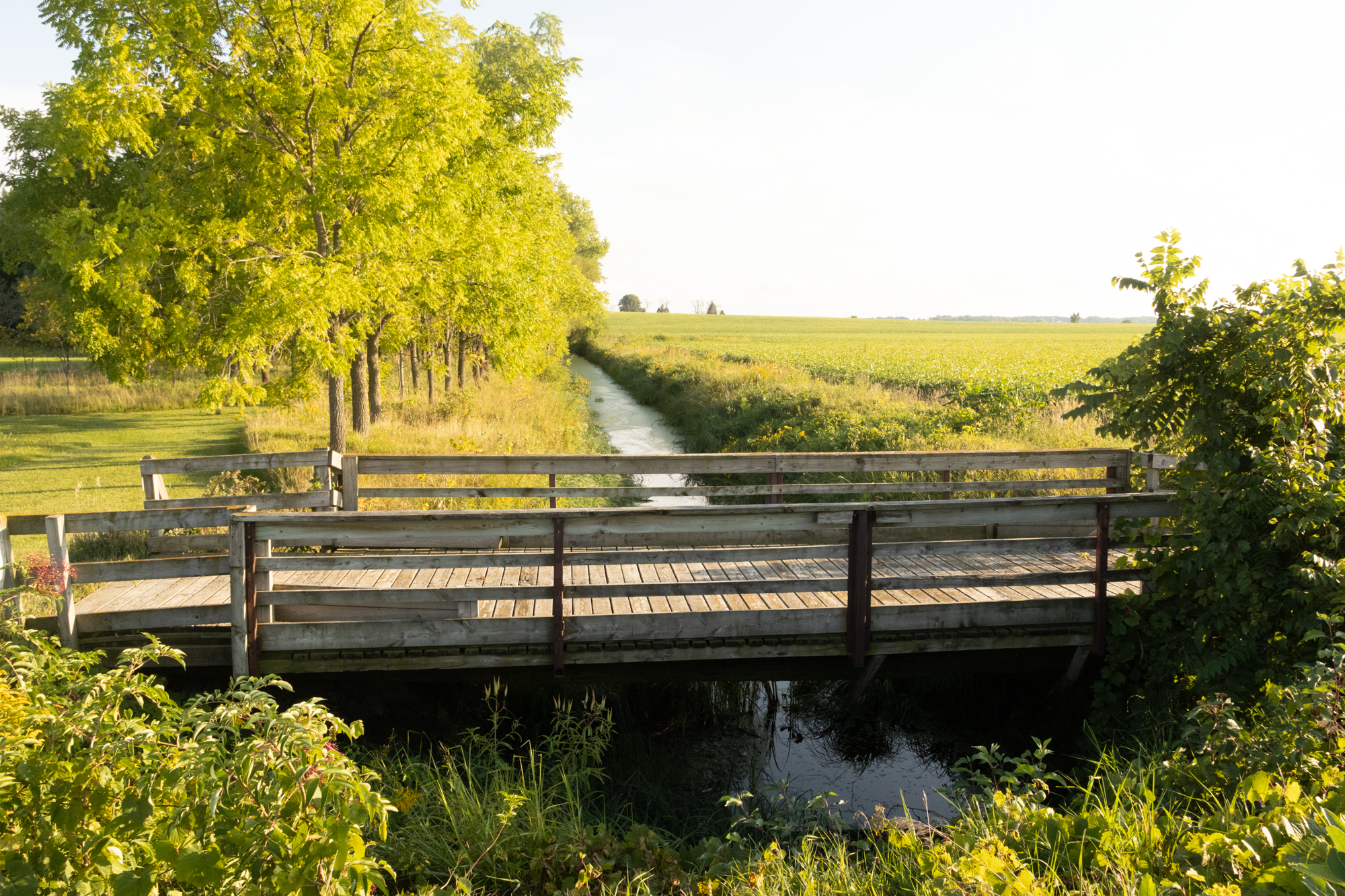
Starkweather Creek, located on Madison’s east side and flowing into Lake Monona, has elevated chloride concentrations due to dense nearby road networks and heavy winter salt use.
To better understand and track long-term trends, CARPC staff and partners have been monitoring chloride levels in the creek since 2020, when initial testing began using test strips. In 2024, continuous monitoring sensors were installed throughout the watershed, significantly expanding data collection efforts and supporting implementation of CARPC’s Starkweather Creek Watershed Chloride Management Plan.

Our Partners
This year marks the launch of CARPC’s Adopt-a-Meter program, which invites local organizations to help cover the annual cost of a monitoring meter and assist with checking on sensors that continuously collect data. Participants this year include the Rotary Club of Madison, UW–Madison’s Chemistry Department, the State Cartographer’s Office, and Friends of Starkweather Creek.

2025 Monitoring Data
Chloride Levels: Average Daily Maximum
| October 2025 | November 2025 | December 2025 | |
| East Branch | 433 mg/L | 451 mg/L | 302 mg/L |
| West Branch | 84 mg/L | 112 mg/L | 154 mg/L |
East Branch Data

Chloride monitoring on Madison’s east side shows a noticeable difference between this winter and last. While December 2024 was marked by a prolonged high-chloride spike, December 2025 has had consistently lower readings overall, with fewer high chloride spikes.
This likely reflects fewer significant snow and ice melting events so far this winter. However, the data also shows that chloride levels rose earlier in the season last year, with elevated readings appearing more often in October and November 2024 than during the same months this year.
Even with the improvement in December, it’s important to note that none of the readings dropped below 50 mg/L. At this threshold can have lethal impacts on the most sensitive aquatic species. Non-lethal impacts may also occur, such as reductions to fish diversity.
West Branch Data

Similar to the East Branch, the West Branch has consistently recorded chloride levels above 50 mg/L in November and December 2025. Chloride concentrations rose above 395 mg/L in mid-December, following a snow and ice melt event.
The West Branch typically experiences lower chloride levels than the East Branch because the watershed has less development and impervious surface, and therefore less road salt application.
Why This Matters
Chloride is different from many other pollutants because it doesn’t break down over time. Once it enters our lakes, rivers, and groundwater, it stays there—meaning today’s salt use can cause long-lasting, irreversible damage to groundwater, putting aquatic life at risk.
To put it in perspective, just one teaspoon of salt can make five gallons of water toxic to freshwater organisms.
Learn More
For more summary statistics and additional charts and graphs, visit the new Starkweather Creek Watershed Monitoring website.